The EPOH HS Protocol™ — Full Explanation
The complete clinical rationale behind the 5-phase LIFES framework — why each phase exists, what it addresses, and how the sequence produces lasting results.
Understanding comes before treatment. Every clinical decision at EPOH begins with listening to the full pattern — not just the lesion.
EPOH was built around a single consistent observation: HS keeps coming back when the internal environment driving it — gut dysfunction, hormonal imbalance, metabolic disruption — is never addressed. The EPOH HS Protocol™ is the structured clinical answer to that gap.
Root-cause, not surface treatment
Every treatment decision traces back to the internal drivers — gut, hormones, metabolism, immune function. Not the lesion.
Sequenced across five clinical phases
The LIFES framework — Lower load, Internal healing, Functional detox, External care, Sustaining remission. Each phase builds what the next requires.
Personalised to each patient's driver profile
Two patients with the same EPOH-DSS stage may need entirely different approaches. The same protocol applied uniformly is not this protocol.
"I did not set out to specialise in HS. The condition found me — through patients who had spent years in the system without ever receiving an explanation for why it kept returning."
Dr. Adil Moulanchikkal — Founder, EPOH
Led by
Dr. Adil Moulanchikkal, BAMS
Ayurvedic Physician · Founder, EPOH · Sushrutha Ayurveda Medical College, Bengaluru · Clinical focus: Hidradenitis Suppurativa
Hidradenitis Suppurativa is, in many ways, the condition that exposes the limits of symptom-focused medicine most clearly. Patients arrive with years — sometimes decades — of antibiotic courses, repeated surgical procedures, and biologic suppression behind them. Their condition has not resolved; in most cases, it has deepened.
What the clinical pattern consistently showed was that the skin was not the origin of the problem. Gut dysfunction, hormonal imbalance, metabolic dysregulation, and immune overactivation were present in nearly every patient — and they were not being addressed. Managing the lesion without correcting these internal drivers was producing a predictable outcome: the condition returned.
The EPOH HS Protocol™ emerged from this observation — a structured, phase-based approach that addresses HS as a systemic condition, not a dermatological one. Not a theory. A clinical response to a repeating pattern.
What the Clinical Record Shows
Patients with significant disease duration — often 5, 10, or 15 years — who have tried multiple treatment cycles without sustained resolution
Identifiable gut dysfunction — often worsened by repeated antibiotic courses — present in the majority of complex cases
Hormonal patterns — particularly androgen dominance and insulin resistance — contributing to flare frequency in women
Internal correction — gut restoration, hormonal rebalancing, inflammatory load reduction — producing sustained improvement where surface treatment had not
"Many patients come to us after trying multiple treatments without long-term relief. What they typically have not received is a treatment aimed at the internal environment driving the skin's behaviour."
— Dr. Adil Moulanchikkal, BAMS
The EPOH HS Protocol™ was not developed from academic theory. It was built from the clinical education that only patients can provide — from the ones who showed what was missing, what was mistimed, and what, when addressed correctly, finally changed the trajectory.
The first teacher
A young woman who had seen eight doctors and been told it was "just an infection" for eight years. When she sat across the consultation room, the tunnels and thickened tissue made it immediately clear this was not a dermatological event — it was a system in turmoil. Her case was the moment of reorientation: HS was not a skin disorder. It was a life disorder.
The lifestyle teacher
A 32-year-old factory worker — explosive flares, every antibiotic tried. When asked to describe a typical day: skipped breakfast, four cups of tea, late lunch, fried evening meal, exhausted by 10pm. It was not a lifestyle. It was an inflammation blueprint. Adjusting four dietary inputs and sleep timing halved his flare frequency without a single new medicine. Routine became the treatment.
The emotional teacher
A woman in her mid-forties who had undergone multiple surgeries. She did not cry about pain. She cried because she had stopped attending family events, stopped buying new clothes, could not hug her children without fear. The lesions were not her heaviest burden. Her identity was. The day she healed emotionally was the day she truly began to heal physically.
The pattern teacher
A young man who kept a meticulous diary of every flare — every food eaten, every stress event, every late night, every workout. When the diary was analysed, the disease stopped being unpredictable. It followed rhythms. It obeyed triggers. It repeated cycles. He called it "a predictable monster." That insight — that HS has a logic — became the foundation of systematic pattern-based clinical mapping.
The humility teachers
Not every case responded smoothly. Not every patient healed on schedule. The patients who did not improve immediately — who forced deeper examination of metabolic and emotional layers that had been overlooked — were the ones who refined the protocol most. HS is not conquered. It is understood, negotiated, and calmed. That understanding came from the patients who taught patience.
"These patients, each in their own way, helped me see that HS is a teacher disguised as an illness. It teaches resilience, discipline, self-awareness, and transformation. Every one of them shaped the doctor I am today. Every one contributed to the birth of EPOH."
— Dr. Adil Moulanchikkal, BAMS
These are not values statements — they are the practical principles that shape how every patient case is assessed and every treatment plan is constructed at EPOH.
The EPOH approach is rooted in Ayurvedic medicine — not as an alternative to understanding HS, but as the most complete framework for explaining why it occurs, why it recurs, and what internal sequence resolves it.
Dr. Adil Moulanchikkal, BAMS · Founder, EPOH
HS lesions are a surface expression of internal dysfunction. Treating the skin is not wrong — but treating only the skin misses where the disease actually lives. Every treatment decision begins with the internal environment: gut function, hormonal state, immune signalling, metabolic health. The skin is addressed within that context, not independently of it.
When HS recurs — after antibiotics, after surgery, after suppression — most patients are told this is simply the nature of the condition. The EPOH position is different: recurrence indicates that the underlying driver has not been corrected. It is not a passive observation; it is a clinical question. What is sustaining this? What has not been addressed?
Two patients with Stage II HS may have entirely different driver profiles — one primarily gut-driven, one primarily hormonal, one primarily metabolic. Applying the same formulation to both patients is not clinical practice; it is a protocol. EPOH does not use protocols in that sense. Every treatment plan is constructed from the patient's specific pattern, not from a category.
Not every patient will achieve full remission. Advanced fibrotic cases, irreversible organ involvement, and complete pancreatic failure create biological limits where correction is not possible. Saying so clearly — rather than offering false hope — is a clinical obligation. The evaluation process at EPOH exists partly to make this determination before treatment begins.
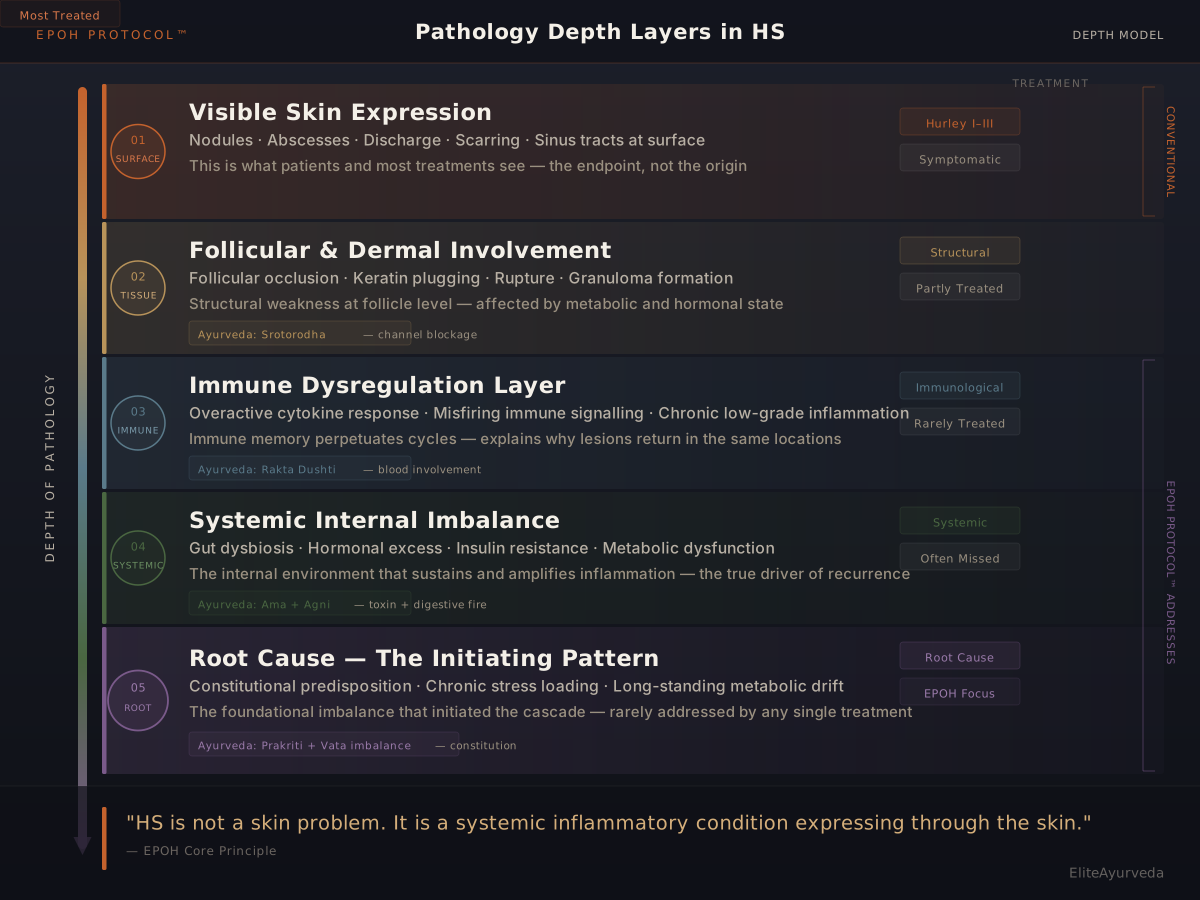
Pathology depth layers — how HS involvement extends from surface lesions to systemic dysfunction
The insights below are not from a single case — they are patterns that appear repeatedly across patients with long-standing, treatment-resistant HS. They form the basis of the EPOH Protocol's phase structure.
In patients with significant disease duration, gut dysfunction — impaired barrier function, disrupted microbiome, weakened digestive capacity — is present in the majority of cases. In many, repeated antibiotic courses have compounded this. The gut-skin axis in HS is not theoretical: correcting gut function reduces inflammatory load in a way that no surface treatment can replicate. The observation that patients who received gut-focused treatment stabilised faster than those who did not is one of the strongest clinical signals that shaped the Protocol.
Women presenting with cyclical flare patterns — intensification around menstruation, or consistent worsening over a hormonal cycle — typically have an androgen-driven or insulin-resistance component that is not being addressed. Managing the flare without rebalancing the hormonal pattern means the same cycle will recur next month. PCOS-linked HS is a particularly clear example of a condition that requires hormonal correction as part of the primary treatment, not as an afterthought.
Attempting to heal tissue before reducing inflammatory load produces limited results. Addressing hormones before stabilising the gut often leads to incomplete hormonal correction. The order in which internal systems are addressed matters — not because of protocol convention, but because of how biological systems interact. Phase F (tissue repair) is more effective when Phase I (gut and hormonal correction) has already shifted the internal environment. This sequencing insight is core to why the LIFES framework is structured the way it is.
Patients maintained on long-term antibiotics or biologics often have stable numbers — controlled flare frequency, acceptable HbA1c equivalents in metabolic terms — but are not in remission. They are suppressed. The moment suppression is reduced, the disease reasserts. True remission is the absence of the internal conditions that drive flare formation — not the chemical prevention of their expression. The long-term aim of EPOH treatment is to produce a stable internal state where the triggers for HS no longer fire, not a state where their expression is blocked.
This is not a GP appointment or a sales consultation. It is a structured clinical assessment. Here is what it covers.
A detailed review of your HS history — onset, progression pattern, location, treatments tried and their effects, and any associated conditions. The duration and trajectory of your disease informs which phases of correction are most urgent.
Assessment of gut function, hormonal patterns, metabolic markers, and immune status where relevant. The aim is to identify which internal systems are the primary drivers of your HS — because this determines what the treatment must address first.
HS behaves differently depending on location, structural pattern, and disease stage. Axillary HS in a patient with PCOS requires a different primary focus than perianal HS in a patient with obesity-linked metabolic dysfunction. Mapping your subtype determines the formulation approach.
Not every patient is a suitable candidate for the EPOH Protocol. Cases with irreversible organ involvement, complete pancreatic failure, or advanced fibrosis beyond biological repair capacity are assessed honestly for response potential. This is not pessimism — it is clinical respect.
If the evaluation indicates suitable response potential, a treatment plan specific to your driver pattern is developed. This is not a printed protocol — it is constructed from your case. Formulations, phase sequencing, and lifestyle modifications are all tailored to your specific situation.
Treatment is not a one-time prescription. As phases progress and internal conditions shift, formulations are adjusted. Clinical response, not calendar time, determines phase transitions. Monitoring continues through remission and into the stabilisation phase.
The Ayurvedic system offers something that most chronic disease frameworks do not: a way of understanding why an individual's body produces a specific pattern of disease, rather than treating the disease as a standard entity.
At EPOH, Ayurveda is not used as a tradition or a philosophy — it is used as a clinical reasoning system. The concepts of Agni (digestive and metabolic function), Ama (accumulated inflammatory load), Rakta Dushti (blood-level imbalance), and Srotorodha (channel blockage and poor lymphatic clearance) map precisely onto the biological mechanisms of HS as understood by modern science.
This framework allows treatment to be personalised to an individual's internal pattern — not their diagnosis. Two patients with the same HS stage can have very different Ayurvedic profiles and require entirely different treatment approaches. That is the value of the framework: it provides the diagnostic structure to make personalisation systematic rather than guesswork.
From Elite Ayurveda to EPOH
Elite Ayurveda was where this approach was first developed — a general Ayurvedic practice that began specialising in complex chronic conditions. As the clinical model matured — from a three-phase framework to a five-phase system refined through hundreds of HS cases — it became clear the work had outgrown a general practice identity. EPOH, Evolution of Elite Ayurveda, reflects that shift. The name changed. The clinical commitment did not.
Ayurvedic Mapping
Agni
=Digestive & metabolic function
Ama
=Accumulated inflammatory load / toxin burden
Rakta Dushti
=Blood-level inflammation driving skin involvement
Srotorodha
=Lymphatic stagnation and poor tissue clearance
Pitta aggravation
=Systemic heat and chronic inflammatory state
"Ayurveda should guide the thinking — not dominate the language."
If your HS keeps coming back despite treatment, it usually means the root cause has not been addressed — not that the condition is untreatable. A clinical evaluation identifies what has been missed and whether this approach is the right fit for your case.
Dr. Adil Moulanchikkal, BAMS · EPOH · +91 88847 22246 · Personalised evaluation required before treatment begins
If you have spent years managing HS without understanding why — this is where that changes.
The complete clinical rationale behind the 5-phase LIFES framework — why each phase exists, what it addresses, and how the sequence produces lasting results.
Explains the gut–skin axis and why gut dysfunction is a primary driver in the majority of complex HS cases — and what addressing it changes.
An honest assessment of which patient profiles show the strongest response potential, and which cases have biological limits that affect outcome.