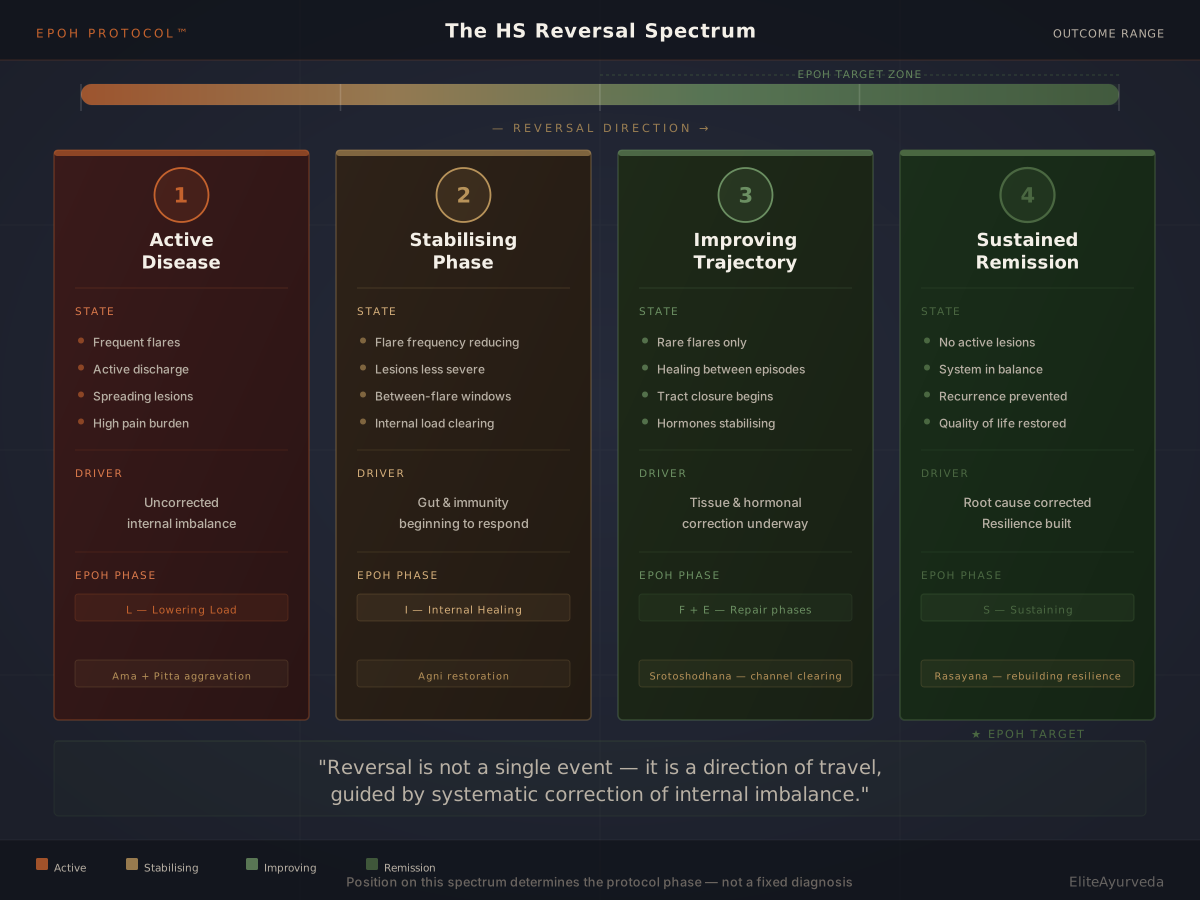
Why "Reversal" Needs a Precise Definition
The word "reversal" is used liberally in discussions of chronic disease management — and in HS specifically, it carries significant weight for patients who have been told their condition is permanent and progressive. When patients ask whether HS can be reversed, they are asking whether they can return to a life without continuous flares, without the social limitations, without the planning their condition currently requires. The answer to that question depends entirely on what reversal actually means — and this requires a definition more precise than "getting better."
Reversal is also frequently misused in both directions. Some practitioners use it to describe any reduction in lesion activity, even temporary suppression that resolves when treatment stops. Others use it to mean only complete absence of any disease activity — a standard that, in advanced HS, may be unrealistic and that generates expectations that undermine the genuine progress patients make. A working definition that is clinically honest and practically useful sits between these extremes.
"HS is not a skin problem. It is a systemic inflammatory condition expressing through the skin."
What Reversal Is Not
Before defining what reversal is, it is useful to be explicit about what it is not — because the mischaracterisations of reversal are more common and more consequential than the definition itself.
Reversal is not suppression. When a biologic reduces lesion frequency while being taken, and disease activity returns to baseline or beyond when it is discontinued, that is suppression — not reversal. Reversal implies a durable change in the internal environment that does not depend on continuous active intervention to maintain. The moment a treatment must continue indefinitely to prevent immediate relapse, it is functioning as management, not reversal.
Reversal is not complete absence of any disease expression. In patients with long-standing HS who have already developed structural tissue changes — scarring, sinus tract remnants, altered follicular architecture — some degree of structural consequence will remain even after the internal drivers are corrected. Reversal does not undo what tissue changes have already occurred; it stops and in some cases gradually reverses the active internal process that was driving those changes. The distinction between structural residue and active disease is clinically important and often underexplained to patients.
Reversal is not a moment. It is not the day a patient is declared "in remission." It is a process that unfolds over months — with identifiable stages, measurable markers, and a trajectory that can be monitored. Treating it as a binary event — either the disease is reversed or it is not — misses the clinical reality of how genuine improvement actually develops.
A Structured Definition — What Reversal Actually Encompasses
In clinical terms, reversal in HS is most accurately defined as the progressive correction of the internal conditions generating the disease, resulting in durable reduction of disease activity that is maintained without continuous suppressive intervention. This definition has several components worth examining separately.
Progressive Correction of Internal Conditions
Reversal begins internally, before it is visible at the skin surface. The gut, hormonal system, and immune regulatory environment — the systems whose dysfunction sustains HS — must be corrected in sequence for the surface expression to change durably. This is why patients who are genuinely in the process of reversal often report a period of weeks to months during which their skin has not dramatically improved but they feel different systemically — better digestion, more stable energy, improved sleep, reduced systemic inflammation. These are the internal markers of reversal that precede and predict the skin changes.
Progressive means the correction happens in stages, not simultaneously. The gut must be stabilised before hormonal correction is fully effective. Hormonal correction must be underway before the immune regulatory environment fully normalises. The sequence is not arbitrary — it reflects the biological relationships between these systems. Attempting to correct all of them simultaneously typically produces a less coherent response than addressing them in the order that reflects their interdependencies.
Durable Reduction of Disease Activity
Durability is the distinguishing characteristic of reversal versus suppression. A reduction in disease activity that persists for weeks without active intervention — where the internal environment has genuinely changed such that it is no longer reliably generating new lesions — is a different clinical phenomenon from a reduction that depends on continuous medication. Durability is assessed over time: three months of reduced activity is more meaningful than three weeks; twelve months is more meaningful than three months.
In practice, patients in the reversal process typically describe a recognisable shift — a point at which the relationship between internal triggers and disease expression changes. Where previously a stressful week or a dietary deviation would reliably produce a flare, they notice that the same trigger no longer produces the same response. This change in trigger-response relationship is one of the earliest observable signs that the internal environment has genuinely shifted — that the system has become less inflammatory rather than simply less symptomatic.
Maintained Without Continuous Suppressive Intervention
This component is important for setting realistic expectations about what reversal requires in maintenance. Reversal does not mean returning to an entirely unrestricted lifestyle with no attention to the factors that originally contributed to HS. It means that the internal environment has been corrected to a point where it no longer requires active suppressive management to remain stable — but it does require the maintenance of the conditions that produced that stability. Diet, sleep, stress regulation, and ongoing hormonal support may continue to be relevant, not as treatments for active disease but as maintenance of a restored internal environment.
The distinction between maintenance and treatment is clinically meaningful. Treatment is directed at correcting something that is actively dysregulated. Maintenance is directed at preserving a functional state that has been achieved. The intensity, cost, and burden of maintenance are substantially lower than those of active treatment — which is why the transition from treatment to maintenance is itself a meaningful marker of reversal progress.
In Ayurvedic clinical understanding, the concept most closely aligned with reversal is Nidana Parivarjana — removal of the causative factors — followed by Prakrit Sthapana, restoration of the body's natural functional state. True reversal in this framework is not simply the absence of symptoms but the restoration of Agni (digestive capacity), Ojas (systemic resilience), and the balanced function of the regulatory channels. This is a more demanding standard than symptom reduction — and one that better captures what sustained remission actually requires internally.
What Reversal Looks Like — Stage by Stage
Stage 1 — Internal Shift (Months 1–3)
The first stage of reversal is almost entirely internal and often invisible to external observation. The systemic inflammatory load begins to reduce; gut function improves; the hormonal environment begins to stabilise. Patients may notice improved digestion, better sleep quality, and reduced systemic fatigue — but skin activity may not have changed significantly and in some cases may temporarily increase as the body processes accumulated inflammatory material. This stage is the most difficult from a patient engagement perspective because the investment is real and the visible return has not yet materialised.
Stage 2 — Reduced Frequency (Months 3–6)
As internal correction continues, the interval between episodes begins to lengthen. Flares that previously occurred monthly begin occurring every six to eight weeks; those that occurred every two weeks begin occurring monthly. The severity of individual episodes may also reduce — abscesses that previously required intervention begin resolving spontaneously; the acute pain phase shortens. These changes are clinically meaningful and mark a genuine shift in the internal-to-surface relationship.
Stage 3 — Reduced Severity and Trigger Sensitivity (Months 6–12)
In this stage, the change in trigger-response relationship becomes clearly observable. Events that previously reliably triggered flares — hormonal cycle phases, stressful periods, dietary deviations — begin producing diminished responses. The skin between episodes shows less residual inflammation; existing lesions heal more completely; new lesions are smaller and less deeply seated. The patient's relationship with their condition begins to shift from active management to monitoring.
Stage 4 — Stable Remission
Stable remission — the closest clinical correlate to what patients mean when they ask about reversal — is characterised by extended periods without new active lesions, stable tissue in previously affected areas, and the absence of the systemic symptoms (fatigue, gut disturbance, hormonal irregularity) that were present during active disease. This is not necessarily permanent or unconditional — significant prolonged stress, major dietary disruption, or hormonal change may produce a limited flare — but the response is different in character from active disease: it is contained, shorter, and recovers more rapidly.
What Reversal Requires — The Non-Negotiable Elements
Based on observed patient patterns, certain elements appear consistently necessary for genuine reversal rather than temporary improvement. Their absence reliably limits how far and how durably the reversal process can proceed.
Gut correction is non-negotiable. Patients who achieve significant hormonal and immune improvement without addressing underlying gut dysfunction consistently experience a ceiling — a point beyond which disease activity does not reduce further, because the gut-generated inflammatory input continues sustaining the baseline that internal correction alone cannot fully overcome.
Hormonal stabilisation is non-negotiable in patients where hormonal involvement is a primary driver. Patients who achieve meaningful dietary and gut correction without addressing androgen excess or insulin resistance typically experience improvements that plateau and regress — because the hormonal environment continues to create the follicular susceptibility that HS exploits.
Consistency over time is non-negotiable. Reversal is not produced by intensive short-term intervention followed by return to previous patterns. It requires sustained correction over sufficient time for internal systems to genuinely reorganise — typically measured in months, not weeks. Patients who understand this at the outset maintain engagement better than those who expect visible results at the pace of suppressive management.
"When a condition keeps recurring, it usually follows an underlying pattern that needs to be understood and addressed — not suppressed."
A Realistic and Honest Assessment
Reversal is achievable — but not universally and not unconditionally. In patients with early-stage HS whose structural tissue changes are limited, comprehensive internal correction can produce stable remission that feels, functionally, like a resolution of the condition. In patients with long-standing Stage III disease, reversal of the internal process is still possible and meaningfully changes quality of life, but structural tissue consequences that have already occurred cannot be fully undone.
Stating this honestly is not pessimism — it is the kind of clarity that allows patients to engage realistically with a treatment process that requires sustained effort. A patient who understands what they can realistically achieve at their current stage, and what internal correction can genuinely accomplish for them specifically, is far better positioned to make an informed decision about whether and how to engage with that process than a patient given either false hope or unqualified pessimism.
The fact that reversal is not guaranteed and not instantaneous does not make it less worth pursuing. It makes it worth pursuing honestly — with a clear understanding of what it requires, what it produces, and what the alternative trajectory looks like when internal drivers are left uncorrected.